
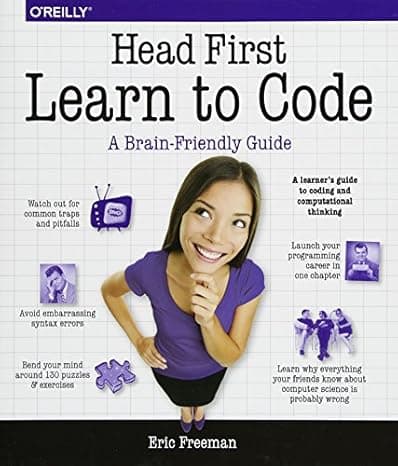
Head First Learn to Code: A Learner's Guide to Coding and Computational Thinking 1st Edition
About this book
What will you learn from this book?
Itâ??s no secret the world around you is becoming more connected, more configurable, more programmable, more computational. You can remain a passive participant, or you can learn to code. With Head First Learn to Code youâ??ll learn how to think computationally and how to write code to make your computer, mobile device, or anything with a CPU do things for you. Using the Python programming language, youâ??ll learn step by step the core concepts of programming as well as many fundamental topics from computer science, such as data structures, storage, abstraction, recursion, and modularity.
Why does this book look so different?
Based on the latest research in cognitive science and learning theory, Head First Learn to Code uses a visually rich format to engage your mind, rather than a text-heavy approach that puts you to sleep. Why waste your time struggling with new concepts? This multi-sensory learning experience is designed for the way your brain really works.
Format
Language
Publisher
SKU
Stack books. Chase the perfect drop.
Time your move, land a perfect stack, and climb the high-score shelf.
Play Book Stack




Sponsored
Tanow helps you turn reading inspiration into action.
Save quotes, organize priorities, and track progress in a cleaner daily workflow built for focus.
Quote capture
Store meaningful lines and revisit them faster.
Daily planning
Keep tasks visible and simple throughout the day.
Habit progress
Build consistency with lightweight progress tracking.
Small actions repeated every day create visible progress.
Product details
From the Publisher

About 'Head First' Books
We think of a Head First Reader as a Learner
Learning isn't something that just happens to you. It's something you do. You can't learn without pumping some neurons. Learning means building more mental pathways, bridging connections between new and pre-existing knowledge, recognizing patterns, and turning facts and information into knowledge (and ultimately, wisdom). Based on the latest research in cognitive science, neuro-biology, and educational psychology, Head First books get your brain into learning mode.
Here's how we help you do that:
We tell stories using casual language, instead of lecturing. We don't take ourselves too seriously. Which would you pay more attention to: a stimulating dinner party companion, or a lecture?
We make it visual. Images are far more memorable than words alone, and make learning much more effective. They also make things more fun.
We use attention-grabbing tactics. Learning a new, tough, technical topic doesn't have to be boring. The graphics are often surprising, oversized, humorous, sarcastic, or edgy. The page layout is dynamic: no two pages are the same, and each one has a mix of text and images.
Metacognition: thinking about thinking
If you really want to learn, and you want to learn more quickly and more deeply, pay attention to how you pay attention. Think about how you think. The trick is to get your brain to see the new material you're learning as Really Important. Crucial to your well-being. Otherwise, you're in for a constant battle, with your brain doing its best to keep the new content from sticking.

Here's what we do:
We use pictures, because your brain is tuned for visuals, not text. As far as your brain's concerned, a picture really is worth a thousand words. And when text and pictures work together, we embedded the text in the pictures because your brain works more effectively when the text is within the thing the text refers to, as opposed to in a caption or buried in the text somewhere.
We use redundancy, saying the same thing in different ways and with different media types, and multiple senses, to increase the chance that the content gets coded into more than one area of your brain.
We use concepts and pictures in unexpected ways because your brain is tuned for novelty, and we use pictures and ideas with at least some emotional content, because your brain is more likely to remember when you feel something.
We use a personalized, conversational style, because your brain is tuned to pay more attention when it believes you're in a conversation than if it thinks you're passively listening to a presentation.
We include many activities, because your brain is tuned to learn and remember more when you do things than when you read about things. And we make the exercises challenging-yet-do-able, because that's what most people prefer.
We use multiple learning styles, because you might prefer step-by-step procedures, while someone else wants to understand the big picture first, and someone else just wants to see an example. But regardless of your own learning preference, everyone benefits from seeing the same content represented in multiple ways.
We include content for both sides of your brain, because the more of your brain you engage, the more likely you are to learn and remember, and the longer you can stay focused. Since working one side of the brain often means giving the other side a chance to rest, you can be more productive at learning for a longer period of time.
We include challenges by asking questions that don't always have a straight answer, because your brain is tuned to learn and remember when it has to work at something.
Finally, we use people in our stories, examples, and pictures, because, well, you're a person. Your brain pays more attention to people than to things.
Editorial Reviews
About the Author
Product details
- Publisher : O'Reilly Media; 1st edition (February 6, 2018)
- Language : English
- Paperback : 639 pages
- ISBN-10 : 1491958863
- ISBN-13 : 978-1491958865
- Item Weight : 2.51 pounds
- Dimensions : 7.9 x 1.2 x 9.2 inches
- Best Sellers Rank: #117,187 in Books (See Top 100 in Books)
- #77 in Object-Oriented Design
- #154 in Python Programming
- #211 in Microsoft Programming (Books)